01
Private AI Server
A controlled AI environment designed around your security, performance, and governance requirements.
 Sign InFree Assessment
Yudaro AI is Yudaro's private business AI service grounded in approved company documents, SOPs, operational knowledge, permissions, and business data. Deploy on dedicated customer hardware or controlled infrastructure to fit your requirements.
Discuss your requirementsReview on-hand stock against your reorder rules, then prepare a purchasing recommendation for approval.
Grounded in approved company sourcesA controlled AI environment designed around your security, performance, and governance requirements.
Turn internal documents, product information, policies, and expertise into a reliable knowledge layer.
Let employees ask precise operational questions and receive answers grounded in approved procedures.
Give new and experienced employees on-demand guidance based on company-specific knowledge.
Summarize information, investigate trends, and support faster, better-informed decisions.
Extract, compare, classify, and summarize information from business documents at scale.
Connect intelligence to workflows so routine requests can trigger controlled, auditable actions.
Private AI is an AI system deployed with controls over its models, data sources, users and infrastructure. It can retrieve approved company documents and help employees interpret them. A private deployment may run on customer hardware or controlled hosted infrastructure; the actual data flow, model provider, retention settings and access controls determine its privacy properties.
Start where employees repeatedly search for the same approved information. A distributor may need product specifications; a service business may need equipment procedures; a restaurant may need station training. Choose a small, maintained document collection before introducing live ERP access.
Discovery establishes the users, information owners and questions worth answering. We map permissions, clean source documents, choose infrastructure and configure retrieval. A pilot uses a business-owned evaluation set: common questions, outdated documents, conflicting answers and requests a user must not be allowed to see. Release follows documented acceptance and employee training.
Compare the full operating model, not only where a model runs. Local hardware requires maintenance and recovery planning. Hosted infrastructure requires review of providers and outbound data paths.
| Decision | Customer hardware | Controlled hosting |
|---|---|---|
| Operations | Agreed team maintains equipment | Hosting responsibilities must be contracted |
| Capacity | Size for model, context and concurrent users | Verify capacity and consumption costs |
| Data flow | Review OCR, embeddings and telemetry too | Review tenancy, retention and external services |
Published AI Foundation starts at $7,500; AI Growth has a typical starting point of $15,000; AI Enterprise is scoped from $30,000. These are planning estimates. Source cleanup, document volume, permissions, hardware and integrations affect cost. A focused pilot can be planned in weeks; complex deployments require a phased schedule after discovery. Measure source accuracy, retrieval success, permission-test results, adoption and handling time.
Bring representative documents, owners, access groups, unanswered questions and authoritative systems. Explain which information must never leave the environment. If the problem is simply disorganized files, a better document library or search system may be the right first step.
Turn approved company experience, values and operating practices into guidance your team can use. Yudaro’s Corporate Culture Intelligence methodology uses governed feedback, role-based access and leadership review to support consistent decisions as your business grows.
No. Retrieval can improve grounding, but answers still need source references, evaluation and an appropriate refusal when evidence is missing.
Not necessarily. Retrieval-augmented generation searches approved material at question time. Fine-tuning changes model behavior and is a separate decision.
Yes, through a scoped integration with verified interfaces, permissions and approval for sensitive actions. A document assistant does not automatically have live ERP access.
We configure Open WebUI around your models, knowledge, permissions, and operating requirements—giving employees a familiar workspace without sacrificing control.
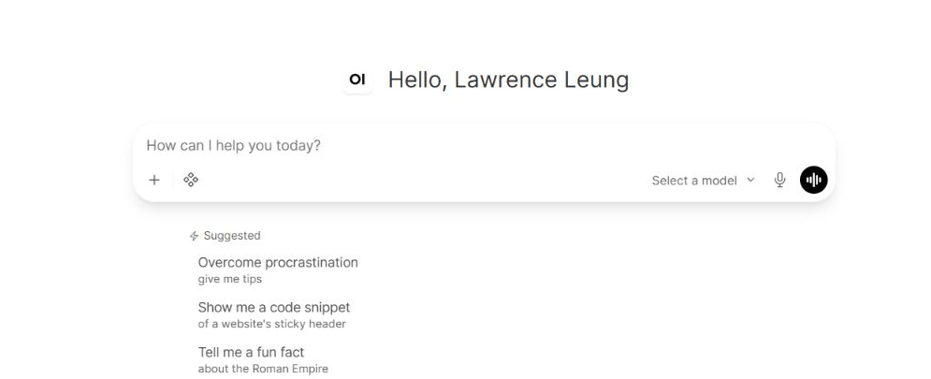
A clear, familiar workspace for approved AI models and company knowledge.
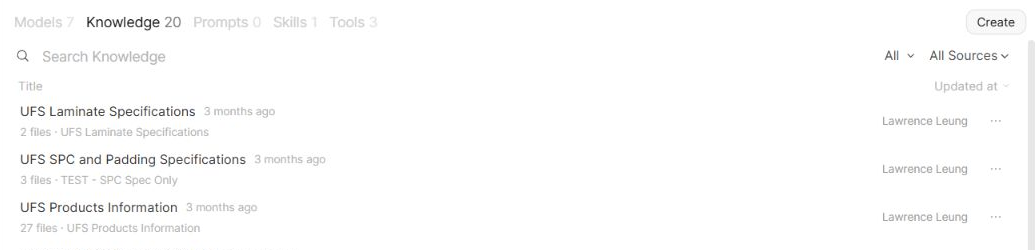
Organize product information, policies and procedures into controlled knowledge collections.
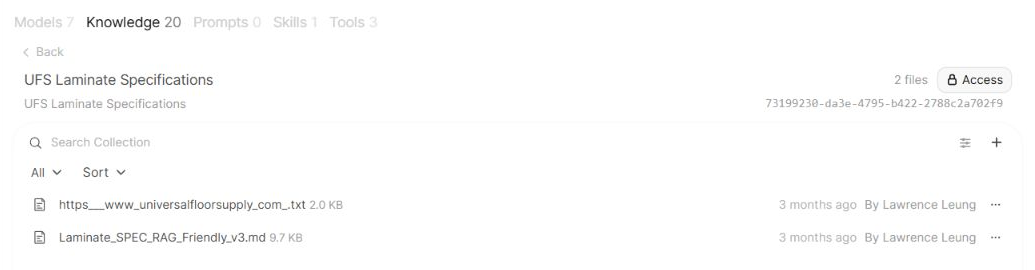
Manage the source documents and access permissions behind your company knowledge.
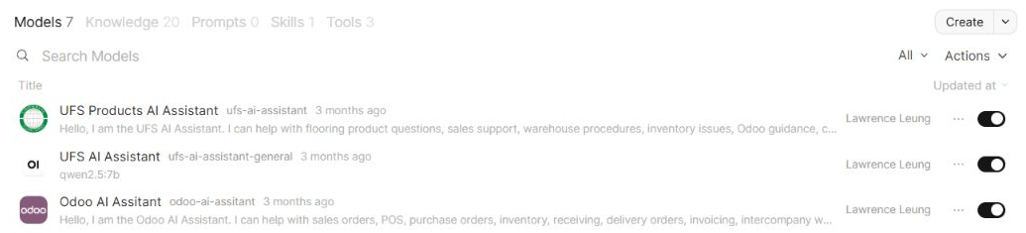
Give each role access to the business assistants and knowledge it needs.